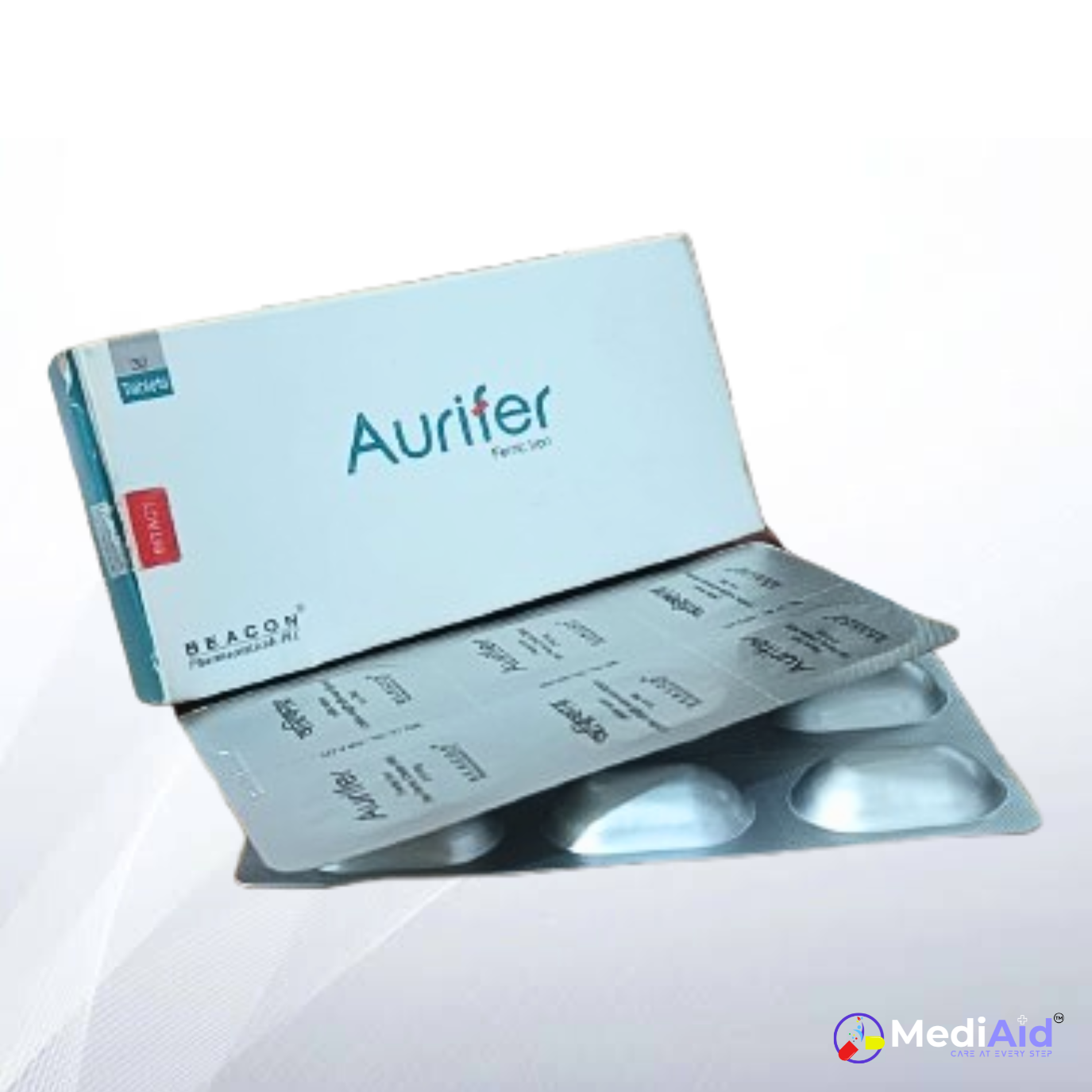
Aurifer
210 mg Tablet|
Unit Price:
৳25.00
|
Strip Price:
৳150.00
(6
Units)
|
|
Box Price:
৳
750.00
(5
Strips,
30 Units)
|
|
Share this page
Indications
Aurifer is an iron-based phosphate binder that helps control phosphate and iron balance in the blood.
Approved Indications:
- Control of Serum Phosphorus in CKD on Dialysis:
Ferric citrate is indicated to control serum phosphorus levels in adult patients with chronic kidney disease (CKD) on dialysis (hemodialysis or peritoneal dialysis).[1] - Iron Deficiency Anemia in CKD not on Dialysis:
Indicated for the treatment of iron deficiency anemia in adult patients with CKD not on dialysis when oral iron supplements alone are insufficient or not tolerated.[1] [2]
Clinically Accepted Off-Label Uses:
- Hyperphosphatemia in CKD Not on Dialysis: Ferric citrate has been studied as a phosphate-lowering therapy in adults with CKD not on dialysis. However, this use is not included in the current U.S. prescribing information as an approved indication. Clinical evidence, including randomized trials and systematic reviews, supports its phosphate-lowering effect in this population, but use should be based on clinical judgment and applicable guidelines.[2] [3] [4]
Dosage & Administration
Adults:
- For Hyperphosphatemia in CKD on Dialysis:[1] [2]
- Initial dose: 2 tablets (each containing 210 mg elemental iron) 3 times daily with meals.
- Titration: Adjust by 1–2 tablets per day as needed to maintain target serum phosphorus levels. Dose may be titrated at intervals of 1 week or longer.
- Maximum daily dose: 12 tablets per day.
- For Iron Deficiency Anemia in CKD not on Dialysis:[1] [2]
- Initial dose: 1 tablet 3 times daily with meals.
- Titration: Adjust the dose as needed to achieve and maintain the target hemoglobin level.
- Maximum daily dose: 12 tablets per day.
Pediatrics:
- Safety and efficacy have not been established in pediatric patients.[1]
Geriatric:
- No specific dosage adjustment is required based on age alone. [1]
Renal Impairment:
- Dosage should be individualized according to the indication and relevant laboratory parameters, including serum phosphorus or hemoglobin.[1] [2]
Hepatic Impairment:
- No specific dosage adjustment recommendation is provided in the prescribing information. Use should be based on clinical judgment and monitoring of iron status.[1]
Route & Administration:
- Oral administration only.
- Must be taken with meals to ensure phosphate binding.
- Swallow whole; do not crush or chew.[1]
Mechanism of Action (MOA)
Ferric citrate has a dual mechanism of action, providing both phosphate-binding activity and iron replacement.
In the gastrointestinal (GI) tract, ferric iron binds to dietary phosphate and forms insoluble ferric phosphate. This complex is excreted in the feces, thereby reducing intestinal phosphate absorption and helping to lower serum phosphorus levels in patients with chronic kidney disease (CKD) on dialysis.[1]
For iron deficiency anemia in CKD patients not on dialysis, ferric iron is reduced to the ferrous form in the GI tract by ferric reductase. The absorbed iron is transported through intestinal enterocytes into the bloodstream, where it circulates bound to transferrin and can subsequently be incorporated into hemoglobin, supporting iron replacement and improvement in hemoglobin levels.[1] [2]
Thus, ferric citrate can provide phosphate control and iron supplementation, depending on the patient's CKD status and treatment indication.[1] [2]
Pharmacokinetics
Absorption:
- Formal pharmacokinetic studies have not been performed with ferric citrate.
- Examination of serum iron parameters has demonstrated systemic absorption of iron from ferric citrate.[1]
- Ferric iron is reduced to the ferrous form in the gastrointestinal tract and subsequently absorbed through intestinal enterocytes.[1]
Distribution:
- Following absorption, iron enters the body's normal iron transport pathways and circulates primarily bound to transferrin.
- Absorbed iron can be utilized for hemoglobin synthesis and incorporated into body iron stores, including ferritin.[1]
Metabolism:
- Ferric iron is reduced to ferrous iron in the gastrointestinal tract and subsequently follows the body's normal iron metabolic pathways.
- Absorbed iron is utilized for erythropoiesis or stored as part of the body's iron pool.[1]
Excretion:
- Bound In the gastrointestinal tract, ferric citrate binds dietary phosphate and forms insoluble ferric phosphate, which is eliminated primarily in the feces.[1]
- Absorbed iron enters the body's normal processes of utilization, storage, and recycling rather than being eliminated as unchanged ferric citrate.[1]
Onset of Action:
- In the gastrointestinal tract, ferric citrate binds dietary phosphate and forms insoluble ferric phosphate, which is eliminated primarily in the feces.[1]
- Iron replenishment may take several weeks to produce significant increases in hemoglobin.
Half-Life:
- Not established. Formal pharmacokinetic studies of oral ferric citrate have not been performed. Some iron is absorbed systemically, while most is eliminated in feces.[1]
Pregnancy Category & Lactation
Pregnancy:
- There Adequate human data on ferric citrate use during pregnancy are unavailable. Use only when clinically indicated after assessing potential benefits and risks. Avoid excessive iron intake.[1]
Lactation:
Therapeutic Class
- Primary Class: Phosphate Binder
- Secondary Class: Oral Iron Replacement Therapy
Warnings & Precautions
- Iron Overload: Monitor serum ferritin and transferrin saturation (TSAT) before and during treatment. Adjust concomitant intravenous iron as clinically indicated.[1] [6]
- GI Adverse Effects: Diarrhea, constipation, or dark stools may occur. Dark stools may mask signs of GI bleeding.
- Laboratory Monitoring: Regularly check serum phosphorus, ferritin, TSAT, and hemoglobin.
- Use in Pediatrics: Not established; avoid use unless specifically directed by a specialist.
- Black Box Warning: None currently.[1]
Side Effects
Common (≥5%):
- Gastrointestinal: Diarrhea, nausea, constipation, abdominal discomfort, dark-colored stools.
Less Common but Clinically Significant:
- Iron overload (with prolonged use or excessive dosing).
- Hypersensitivity reactions (rare).
Serious or Rare:
- Significant iron accumulation leading to iron toxicity.
- Severe GI bleeding if an underlying GI lesion is present but masked by dark stools.
Onset:
- GI side effects generally appear early in treatment. Iron overload develops gradually with chronic overuse.[1]
Drug Interactions
- Doxycycline: Take at least 1 hour before ferric citrate.[1]
- Ciprofloxacin: Take at least 2 hours before or after ferric citrate.[1]
- Other Oral Medications: Consider dose separation when reduced drug absorption could affect clinical efficacy or safety.[1]
- Food: Take with meals as prescribed.[1]
Enzyme Involvement:
Recent Updates or Guidelines
- No major changes to indication or dosing in recent FDA, EMA, or KDIGO updates.
- Emphasis remains on regular monitoring of iron stores to prevent overload.
- Still included in KDIGO and other CKD-MBD guidelines for managing hyperphosphatemia and iron deficiency in CKD.
Storage Conditions
- Temperature: Store at 20°C to 25°C (68°F to 77°F); excursions permitted between 15°C–30°C (59°F–86°F).[1] [6]
- Humidity: Keep bottle tightly closed and store in a dry place.
- Light Protection: Standard amber containers are used; protect from excessive moisture.
- Special Handling: Do not crush or chew tablets.
- Reconstitution: Not applicable.
References
Package Image